

The best gelato in Rome almost derailed the entire trip. I’d been doing fine, eating carbonara and cacio e pepe and cheap house wine like a responsible adult, and then I had one genuinely extraordinary scoop of pistachio gelato on a hot June afternoon somewhere in the backstreets and suddenly I was rerouting my entire itinerary around finding the next one. Rome in mid-June is brutal. The heat comes off the cobblestones. The tourists are everywhere. And the gelato is, at its best, one of the finest things you will put in your mouth in Italy.
The problem is that most visitors eat terrible gelato in Rome because it is everywhere and most of it is bad. The brightly colored mountains of fluorescent gelato you see in the windows near the Colosseum and the Spanish Steps are made from powder, artificial flavoring, and whatever is cheapest.
The same rule applies whether you’re looking for the best pizza in Rome or the best gelato, walk away from the monument until you can no longer see it. Real gelato in Rome is dense, understated, and stored in covered metal containers called pozzetti that keep it at the correct temperature. If the shop has a mountain of luridly colored product displayed in open tubs, walk past.
For everything else worth eating in Rome before and after the gelato, our Rome food guide has you covered.
Ready to book your Rome trip?
How to Spot the Best Gelato in Rome Italy
Before the list, the most useful thing you can learn: how to tell good gelato from bad before you spend any money on it.
The pozzetti test. The best gelaterie in Rome store their gelato in covered metal containers, not piled high in open tubs. The covered containers maintain temperature and texture. If you can see the gelato from the street in a dramatic colored mountain, it is almost certainly not artisan gelato. If you’ve already eaten your way through the best pasta in Rome and the best restaurants in Rome, gelato is the natural way to finish any afternoon in the city.
The color test. Real pistachio gelato is a muted, slightly greyish green. It is not neon. Real strawberry is a pale, natural pink. Anything unnaturally bright is artificial coloring and tells you everything you need to know about what else went into it.
The location test. The best gelato in Rome is almost never on the street immediately adjacent to a major monument. It is two or three streets away, in a shop with no signage visible from the tourist flow, with a short menu and a local crowd. The worst gelato in Rome is within eyesight of the Colosseum.
The price test. A small cup or cone of genuinely artisan gelato in Rome runs €2.50-3.50. If you’re being offered two scoops for €1, something has gone wrong somewhere in the supply chain.
The banana test. If a gelateria has banana flavored gelato it almost certainly uses artificial flavoring since fresh banana gelato oxidizes and turns brown within hours. Not a dealbreaker but a useful signal about how the kitchen thinks.
Find Gelato in Rome by Neighborhood
Find the Best Gelato in Rome by Neighborhood
Select a neighborhood to see our picks.
Select a neighborhood above to see our gelato picks.
Best Gelato in Rome — The Gelaterie Worth Finding
Come il Latte — The Overall Best
Come il Latte near Termini station does something so obvious it’s remarkable nobody else thought of it first: they coat the inside of their cones in molten chocolate before filling them with gelato. The chocolate hardens, creating a layer between the cone and the ice cream that keeps the cone crisp and adds a snap to every bite. The gelato itself is exceptional, stored in pozzetti, made with natural ingredients, and available in flavors that rotate with the season. The pistachio is the benchmark and the stracciatella the crowd favorite, but the ricotta with honey is the one worth going specifically for. One of the genuinely great gelato experiences in Rome Italy.
Address: Via Silvio Spaventa 24-26, near Termini
Price range: €2.50-4
Best for: The chocolate-lined cone, pistachio, ricotta with honey, overall quality
Book: walk-ins only — comeillattegelato.com
Gelateria del Teatro — Best in the Historic Center
Gelateria del Teatro near Piazza Navona is one of the few places in Rome where you can watch the gelato being made in real time behind the counter, which tells you something about how confident the kitchen is in what it’s doing. The fruit flavors are the standout here: kiwi, peach, bergamot, seasonal combinations that taste exactly like the ingredient they’re named after rather than a laboratory approximation of it. The flavors rotate constantly with what’s fresh and in season, which means it’s worth going twice if you’re in Rome for a few days.
Address: Via dei Coronari 65, Historic Center
Price range: €2.50-4
Best for: Fruit flavors, watching the gelato being made, Piazza Navona area
Book: walk-ins only — gelateriadelteatroroma.it
Otaleg — Best Artisan Gelato in Trastevere
Otaleg, which is gelato spelled backward if you hadn’t already noticed, has become one of the most talked-about artisan gelaterie in Rome since opening in Trastevere. The slow-making process and obsessive ingredient sourcing produce flavors with an extraordinary consistency, dense and intense without being heavy. The pistachio uses real Sicilian pistachios. The chocolate is properly dark. The more adventurous flavors, gorgonzola and pistachio with sea salt, cacio e pepe gelato (yes, really), fava beans with pecorino, have developed something of a cult following among serious food people in Rome. Whether you want the classics or something genuinely experimental, Otaleg is the answer.
Address: Via Ettore Rolli 21, Trastevere
Price range: €2.50-4
Best for: Artisan gelato, Trastevere location, creative and experimental flavors
Book: walk-ins only
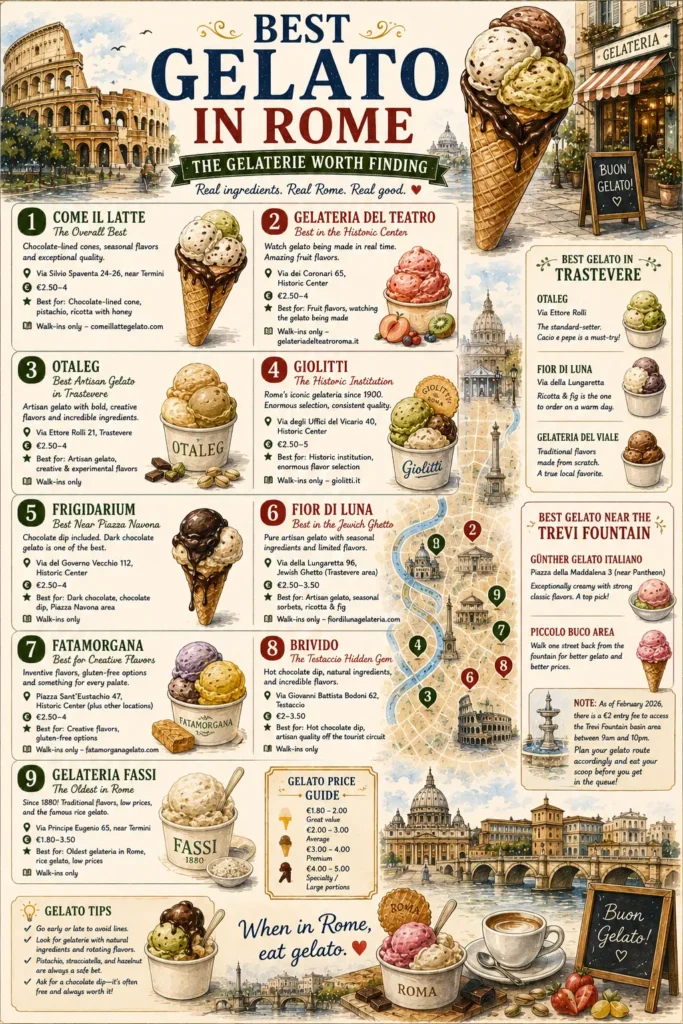
Giolitti — The Historic Institution
Giolitti has been serving Romans since 1900, supplied cream to the Italian royal family, and was visited by the Obamas on a state trip. The name is practically synonymous with gelato in Rome for a generation of Romans who grew up eating here. The range of flavors is enormous, the quality consistent, and the full-service bar means you can have coffee alongside your scoop if the afternoon warrants it. The ordering system requires paying first at the counter, then presenting your receipt for the gelato. Go for the classics: pistachio, nocciola (hazelnut), stracciatella. This is not the most cutting-edge gelato in Rome but it is one of the most reliably excellent.
Address: Via degli Uffici del Vicario 40, Historic Center
Price range: €2.50-5
Best for: Historic institution, enormous flavor selection, the full classic Rome gelato experience
Book: walk-ins only — giolitti.it
Several of the best Rome food tours end with a stop at exactly the kind of gelateria we cover here. Our Rome food tours guide has the full breakdown by neighborhood.
Frigidarium — Best Near Piazza Navona
Frigidarium near Piazza Navona is one of the most consistently excellent and most reliably busy gelato shops in the historic center. The signature move is offering to dip your gelato in white or dark chocolate at no extra charge, which hardens into a crunchy shell around the scoop. The dark chocolate gelato here is one of the best in Rome. The bergamot flavor, when they have it, is exceptional. There’s almost always a queue but it moves fast. Worth every minute.
Address: Via del Governo Vecchio 112, Historic Center
Price range: €2.50-4
Best for: Dark chocolate, the chocolate dip, Piazza Navona area, reliable quality
Book: walk-ins only
Fior di Luna — Best in the Jewish Ghetto
Fior di Luna in the Jewish Ghetto is the gelateria that serious Rome food people point to when they want to explain what artisan gelato actually means. The selection is deliberately limited: never more than a dozen flavors at any time, all made from ingredients sourced from Italian farms, all free of artificial flavoring and coloring. The seasonal fruit sorbets are extraordinary, the ricotta and fig combination is one of the great gelato pairings in Rome, and the understated shop front means you have to know to look for it. Locals queue here. This is a good sign.
Address: Via della Lungaretta 96, Trastevere area (Jewish Ghetto adjacent)
Price range: €2.50-3.50
Best for: The purest artisan gelato in Rome, seasonal fruit sorbets, ricotta and fig
Book: walk-ins only — fiordilunagelateria.com
Fatamorgana — Best for Creative Flavors
Fatamorgana is the gelato shop for people who find the classics a little predictable. The flavors here are genuinely inventive: ginger and pineapple, violet and lemon, ricotta and pear, Sicilian almond and cardamom. Everything is made without gluten, dairy alternatives are available, and allergens are clearly marked for every flavor, which is rare and genuinely useful. Multiple locations across Rome including one near the Colosseum and one in Trastevere. The creative flavors are the point here, though the classics are executed well too.
Address: Piazza Sant’Eustachio 47, Historic Center (plus other locations)
Price range: €2.50-4
Best for: Creative and experimental flavors, gluten-free options, adventurous gelato eaters
Book: walk-ins only — fatamorganagelato.com
Brivido — The Testaccio Hidden Gem
Brivido in Testaccio has been making traditional artisan gelato every day since 1986, in a neighborhood that the tourist gelato circuit hasn’t fully discovered yet. Everything is natural: no artificial coloring, no chemical preservatives, no sweeteners. The signature move is dipping your gelato in hot chocolate before serving it in a cone, which hardens around the scoop and creates something slightly more elaborate than Frigidarium’s version. The sugar-free chocolate and the salted peanut are the standout flavors. If you’re already heading to Testaccio for the pasta and the pizza al taglio at Da Remo, Brivido is a ten minute walk away and a genuinely excellent finish to the afternoon.
If you’re already heading to Testaccio for pizza al taglio at Da Remo, which we cover in our best pizza in Rome guide, Brivido is a ten minute walk away.
Address: Via Giovanni Battista Bodoni 62, Testaccio
Price range: €2-3.50
Best for: Testaccio hidden gem, hot chocolate dip, artisan quality off the tourist circuit
Book: walk-ins only
Gelateria Fassi — The Oldest in Rome
Gelateria Fassi near Vittorio Emanuele metro stop has been in business since 1880, making it the oldest gelateria in Rome and one of the oldest in Italy. The room is enormous and beautifully old-school, the prices are among the lowest you’ll find for genuinely quality gelato in Rome (starting at under €2), and the flavors are traditional rather than experimental. The rice gelato, a house specialty, is creamy and unusual and worth ordering even if the description gives you pause. An institution in every sense.
Address: Via Principe Eugenio 65, near Termini
Price range: €1.80-3.50
Best for: The oldest gelateria in Rome, classic traditional flavors, rice gelato, low prices
Book: walk-ins only

For a different perspective on the city after your gelato crawl, our best rooftop restaurants in Rome covers the best spots to watch the Roman sunset from above.
Best Gelato in Trastevere Rome
Trastevere has become one of the best neighborhoods in Rome for artisan gelato, partly because the neighborhood’s food culture generally resists the worst tourist trap instincts, and partly because Otaleg and Fior di Luna have raised the bar for what gelato here can be.
Otaleg on Via Ettore Rolli is the current standard-setter, the place Rome food people send each other when someone asks where to go for the best gelato in Trastevere Rome. The cacio e pepe flavor alone is worth a dedicated visit.
Fiordiluna on Via della Lungaretta is the quieter option, limited flavors, seasonal ingredients, zero artificial anything. The ricotta and fig is the one to order on a warm summer afternoon.
Gelateria del Viale is a small local favorite in Trastevere offering traditional flavors like pistachio and stracciatella made from scratch, the kind of neighborhood gelateria that Romans visit on a Tuesday evening with no particular occasion.
If gelato has inspired you to get hands-on with Italian food, our guide to the best cooking classes in Rome is the natural next step.
Best Gelato in Rome Near the Trevi Fountain
The area around the Trevi Fountain has improved significantly for gelato in recent years, though the tourist trap options still vastly outnumber the good ones.
Günther Gelato Italiano near the Pantheon (a short walk from the fountain) is the most consistently cited recommendation for this part of Rome. Exceptionally creamy with strong classic flavors: multiple chocolates, berry combinations, and a stracciatella that several regulars describe as the best in the city.
Address: Piazza della Maddalena 3, near Pantheon (also Via della Panetteria 42, near Trevi Fountain)
Piccolo Buco (yes, the pizza place) is also near the Trevi Fountain and the neighborhood around it has a handful of decent gelaterias if you know to avoid the neon-lit options on the main tourist drag. Walk one street back from the fountain in any direction and the quality immediately improves.
Note: As of February 2026, there is a €2 entry fee to access the Trevi Fountain basin area between 9am and 10pm. Plan your gelato route accordingly and eat your scoop before you get in the queue.
Best Gelato Flavors in Rome
Rome doesn’t have specific regional gelato flavors the way some Italian cities do, but a few are worth knowing before you order.
Pistachio (pistacchio): The benchmark flavor for testing any gelateria. Real pistachio gelato is muted greyish-green, made from Sicilian pistachios, and intensely nutty without sweetness dominating. Neon green pistachio is a red flag.
Stracciatella: Fior di latte (sweet cream) base with shards of dark chocolate. The Roman classic. Simple, satisfying, and the thing to order when you want to understand what a gelateria does with quality milk.
Nocciola (hazelnut): Piedmontese hazelnuts make the best version. Look for a deep brown color and an intensely nutty flavor. Giolitti’s nocciola is one of the benchmarks.
Ricotta and fig: A semi-savory seasonal flavor that shows up in late summer and is one of the more specifically Roman gelato combinations. Fior di Luna does the best version.
Fior di latte: Sweet cream gelato with no additional flavoring. The purity of the milk is the entire point. If a gelateria’s fior di latte is excellent, everything else will be too.
Cacio e pepe gelato: Only at Otaleg in Trastevere. Sounds insane. Tastes extraordinary. Worth ordering once just to be able to say you did.
What to Know Before You Order Gelato in Rome
Pay first at the counter. Most gelaterie in Rome operate on a pay-first system. Go to the cashier, pay for your size, take your receipt to the gelato counter, and choose your flavors. First-timers often make the mistake of going directly to the gelato and standing there looking confused.
Cone or cup? Cones are generally better for the eating experience, cups are better if you want to take your time or are eating with children. A small cup or cone typically allows two flavors. Larger sizes allow more. Don’t be greedy: two excellent flavors is better than four mediocre ones.
Eat it immediately. Gelato melts faster than ice cream because it contains less fat and is served at a warmer temperature. This is a feature, not a bug, it’s why the texture is so good. But it means you eat it now, not in ten minutes.
Avoid the tourist gelato. The mountains of brightly colored gelato near every major monument in Rome are made with powder and artificial flavoring. The price is low because the ingredients are cheap. Walk away, walk two streets in any direction, and find the pozzetti.
Summer is peak season. The best gelato in Rome Italy is available year-round but summer is when the fruit flavors peak and when eating gelato in the street makes the most visceral sense. A genuinely excellent scoop of mango sorbet on a 35-degree June afternoon in Rome is one of life’s more reliable pleasures.
Planning Your Trip to Rome?
Find flights, book your hotel, and explore everything Rome has to eat.
Best Gelato in Rome FAQ
What is the best gelato in Rome?
The best gelato in Rome depends on what you’re looking for. Come il Latte near Termini is the overall benchmark for quality and the chocolate-lined cone is the signature experience. Otaleg in Trastevere is the best for artisan and experimental flavors. Giolitti near the Pantheon is the historic institution with the widest flavor selection. Gelateria del Teatro near Piazza Navona is the best for fresh fruit flavors.
How do you spot authentic gelato in Rome?
Real artisan gelato in Rome is stored in covered metal containers called pozzetti rather than displayed in open colorful mounds. The colors are natural and muted rather than artificially bright. The shop is usually a few streets away from major monuments rather than directly adjacent to them. A small cup typically costs €2.50-3.50.
What is the best gelato flavor in Rome?
Pistachio is the benchmark flavor for testing any gelateria in Rome. Real pistachio gelato is grey-green, made from Sicilian pistachios, and intensely nutty. Stracciatella (sweet cream with dark chocolate shards) is the Roman classic. Ricotta and fig is the most specifically Roman seasonal combination. Cacio e pepe gelato at Otaleg is the most adventurous option.
Where is the best gelato in Rome near the Trevi Fountain?
Günther Gelato Italiano near the Pantheon (a short walk from the Trevi Fountain) is the most consistently recommended option in this part of Rome. Most gelaterias immediately adjacent to the Trevi Fountain itself are tourist traps. Walk one street back from the fountain in any direction and the quality improves significantly.
What is the difference between gelato and ice cream?
Gelato contains less fat and less air than ice cream, is served at a warmer temperature, and is therefore denser and more intensely flavored. It also melts faster, which is part of why it’s better eaten immediately and in the street rather than sitting at a table with it. Roman gelato in summer, eaten while walking through a Trastevere side street, is a fundamentally different experience from ice cream.